If I had to choose one song whose words described---in general---the way I feel about life, this one would probably be it. Especially right now when I'm trying to figure out what to do with mine. (Sorry in advance; the video isn't that great.)
Thursday, March 31, 2011

Wednesday, March 16, 2011
The oh-so-dreaded college finals
Successes: turned in 14-page communications paper; got an A on my 100-question comprehensive biology final (does little jig of celebration.)
To go: comprehensive math final to be taken tomorrow morning; 8-page history paper to be turned in tomorrow night.
When-it's-all-said-and-done: Math and I, we're not friends. I won't complain one single ounce if I don't ever have to take another math class ever again in my entire whole life.
To go: comprehensive math final to be taken tomorrow morning; 8-page history paper to be turned in tomorrow night.
When-it's-all-said-and-done: Math and I, we're not friends. I won't complain one single ounce if I don't ever have to take another math class ever again in my entire whole life.
Saturday, February 26, 2011
Friday, February 4, 2011
Just Bein' Honest
Alright. I'm little discouraged. I don't know what to do with my life; I don't know where to go to school. And even if I did know, I don't have any money to go to school---not really. I'm filling out scholarships left and right, but the only thing I've sort-of-kind-of got going for me is that I'm female. I'm not Latino or Native American or African American. I'm not pregnant. I'm not a single mother. I don't have any disabilities. Seems like they only give money to all of the above mentioned.
... OH, bother!

Amen to that.
... OH, bother!
Amen to that.
Tuesday, January 11, 2011

At that early period it served but to bewilder her. It moved her to dreaming, to thoughtfulness...
In short, [she] was beginning to realize her position in the universe as a human being, and to recognize her relations as an individual to the world within and about her. This may seem like a ponderous weight of wisdom to descend upon the soul of a young woman... But the beginning of things, of a world especially, is necessarily vague, tangled, chaotic, and exceedingly disturbing.
Even as a child she had lived her own small world all within herself. At a very early period she had apprehended instinctively the dual life---that outward existence which conforms, the inward life which questions."
The Awakening, by Kate Chopin
Photo by Kayli Hankins
Wednesday, January 5, 2011
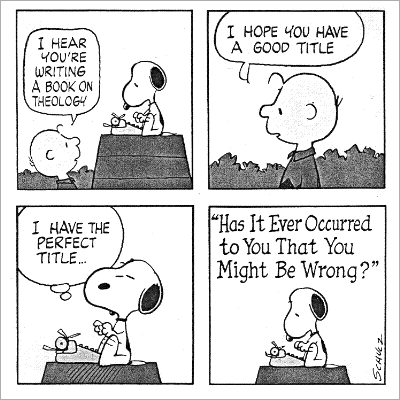
Convince me.
Day one of my second term of my first year of college. I walk into my first class, Biology 102, and sit down. The professor introduces herself and wastes no time in explaining the purpose of this term's course. "Today," she says, "we will begin our study of the process of evolution."
"Greeeaaat," I groan inwardly---but then I check myself.
If you stopped me on the street one day and asked me my beliefs about the world and how it came into being, I would describe myself as a young-earth creationist. That said... I decided a while ago that I ought to be more "open-minded" about other views concerning the beginning of life. One of the most prominent of these views, even among Christians? Evolution.
I know there are a lot of Christians who believe that God did indeed create the world---only they believe He used evolution as His tool. I can see the draw to this belief; there seems to be a lot of evidence for evolution. I think our responsibility is to determine (by our own study and research) whether or not that "evidence" is accurate and true---be it evidence for evolution and an old earth, or evidence for creation and a young earth. To quote Albert Einstein, "The important thing is to not stop questioning."
If there is any particle of matter in "the process of evolution" that really truly seems to make sense, I hereby solemnly swear to consider it. And if it does not contradict what I believe to be true in the Bible (i.e. cavemen evolving into people, which contradicts the Bible's record of Adam and Eve), well then---by all means---hit me! Show me what you've got! I'm listening.
This morning when I walked into Biology class I was ready to listen with an open, considerate mind. If something didn't make sense to me, I raised my hand and asked about it. Honestly... I raised my hand a lot. The professor probably hates me already.
"A fossil is an impression or remnant of a living organism that lived in the past. An impression of a fish in a rock is a fossil; a piece of petrified wood is a fossil; a dinosaur bone is a fossil. Keep in mind that a remnant does not have to be petrified to be a fossil---shark teeth found on the beach, for example, are also fossils."
I raised my hand. "How old does an impression or remnant have to be before it's considered a fossil?" She didn't answer, so I went on, "... because, well, if any remnant of a living organism from the past is considered a fossil, would then, so to speak, my great-grandfather's body buried in a cemetery five years ago be a fossil?"
Silence from the front of the room. Then, "That's a good question..."
"Oh." I was a little confused. "Well, how do scientists determine the age of a fossil in the first place?"
She clicked to another power point slide. "All creatures---people included---consume carbon from the environment and incorporate it into their bodies," she explained. Then she continued, "There is a form of carbon called Carbon 14 that decays naturally over time, and because we know how many years it takes for Carbon 14 to decay from a dead body (5,600 years), we are able to determine how old a fossil is by assessing how long the Carbon 14 has been decaying from it."
"Ooh," I said. Then I asked the next logical question (or one of them): "People can't live as long as 5,600 years; I mean, somebody couldn't sit over a dead body for 5,600 years and asses its Carbon 14 until it completely decayed, right...? Heh-heh," I laughed at myself. She looked at me with a straight face. I cleared my throat a little, "My point is... how do scientists know how long Carbon 14 takes to decay?"
"Because," she gave a slightly exasperated sigh, "they've measured how long it has taken the Carbon 14 to decay in fossils they've already found."
She went on to the next power point slide, and I sat in my chair and thought. According to this professor, scientists determine the age of fossils by measuring how long their Carbon 14 has been decaying... and they know how long it takes for Carbon 14 to decay (several thousand years) because they've measured how long it takes to decay in fossils...
Maybe I'm confused---but isn't that circular reasoning?
Evolution, so far I'm not convinced.
Subscribe to:
Posts (Atom)